2026 | Maritime MuseumGraphicDigitalEnvironmentalExhibitionMultimediaPrinted Media
Maritime Museum 90. anniversary exhibition “The Beginning”

The anniversary exhibit unfolded across three rooms, tracing the museum’s founding, moments of glory, and the eve of its temporary closure before WWII. The narrative – brought to life only from a dozen photos and memories – didn’t live in individual exhibits, but flowed through the space.
Monochrome lighting, original music recordings from 1930s, and a spatial video collage created an environment that visitors could experience.
Come on in – outdoor campaign dedicated to the museum
In addition to building the exhibition, we took care of a fair share of marketing materials, starting with an outdoor campaign.


The campaign was launched in two stages. First marked the 90th anniversary year of the Estonian Maritime Museum and then invited to the exhibition “The Beginning.” Visual continuity and seasonal blossoming was tied together time, place, and message into a unified whole.
The historic diving suit at the heart of the design is one of the museum’s earliest artefacts, also displayed in the exhibition.

The beginning
The first exhibition room introduces the origins of the museum: where it began and why it was created. A public call to collect maritime artefacts laid the foundation for the museum. A catalogue from 1930s offered valuable insight into how the original exhibition was structured and experienced by visitors. An aerial photograph of the Port of Tallinn on the wall further anchored the story in its historical location.
Reconstructing the first museum
At the heart of the room stands a detailed scale model of the museum’s first building: a historic warehouse reconstructed from limited archival material. Based on a handful of photographs, we created a 3D model that was later crafted into a physical object.
The model reveals the dense, “wunderkammer-like” character of the early exhibition. Inside the display case, a screen with directional audio presents a short video about the museum’s early years, complemented by archival photographs of the building and its surroundings.
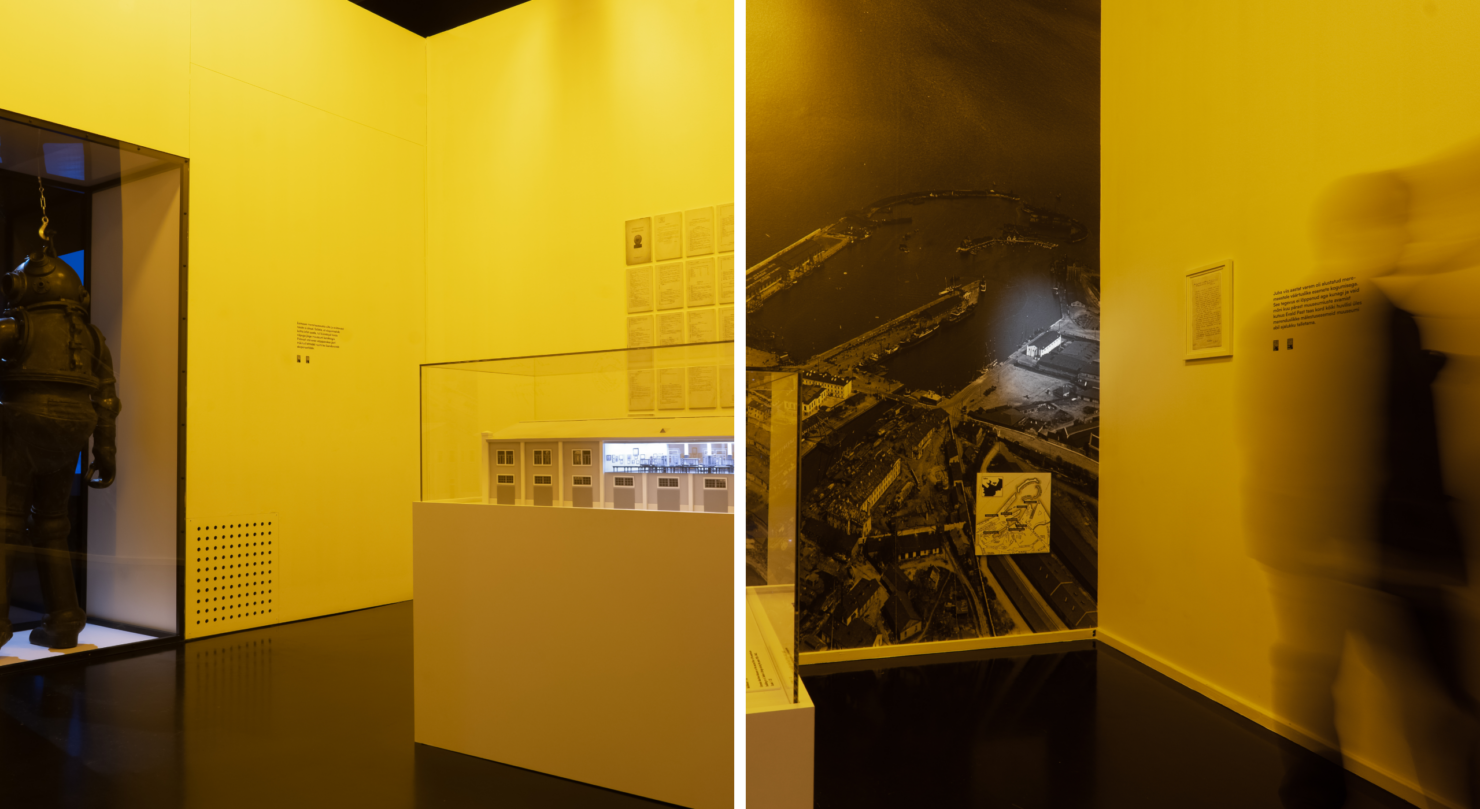
An atmospheric presence: creating a monochrome environment. In real life
The spatial design of the room is intentionally minimalist and calm. Objects are given space, allowing visitors to explore the narrative without visual overload and at their own pace.
The atmosphere is defined by low-pressure sodium lighting, which casts a narrow-spectrum yellow-orange glow across the room. Under this light, colors fade into a near-monochrome environment reminiscent of an old photograph. Rather than highlighting individual objects, the lighting creates an immersive temporal layer, inviting visitors not only to observe history but to step into it.

Silent film tells a story
The next room is dedicated to multimedia. From a handful of archival photographs and sailors’ fading memories, a silent-film-inspired animation reconstructs the Maritime Museum’s war-lost origins.
Told across two screens and layered projections, intertitles, collage, and stylised motion conjure a world that actually was never captured on film, accompanied by authentic 1930s stage music.
The result? A celebration!
By bringing together memories, personal stories, photographs, and historical artefacts, the exhibition became a heartfelt tribute to the dedication and passion that have shaped the Maritime Museum over the years. Curators, museum staff, and maritime enthusiasts from many places came together to share in a moment of collective curiosity and celebration.
Team
- Keijo Kraus – Creative lead & designer
- Kristo Pajus – Producer
- Andrus Lember – Art director of prints
- Magnus Haravee – Graphic designer
Partners
- Gunnar Hunt (KAGU_the_agency) – Content designer & creative
- Joanna Juhkam (Loome Luup OÜ) – Miniatures
- Valdo Praust – Music digitising
- SA Eesti Meremuuseum, Rahvusarhiiv – Archival materials
- Urmas Dresen, Mihkel Karu – Curators
- Ruth Ristmägi, Andres Eero, Alo Ervin, Laura Jamsja, Oksana Leontjeva, Meeli-Heli Lepna, Eve Paavel, Evelyn Silmet – Artefacts preparation
- Villu Plink – Installation
- Joon Stuudio OÜ – Framing
- Hille Saluäär – Text editor
- Toimetaja Translation Bureau – Tranlsator
- Helina Torv, Valter Vaht, Tõnis Veltman – Technical solutions
- Helene Uppin, Kristel Bultot, Carmen Kõrvek – Museum education
- Kadi Karine – Digital guide creation
- Iris Tomson – Marketing
- Anna-Liisa Õispuu – Project lead of the Maritime Museum team
- Andres Ojasu (Trage OÜ) – Production